

Business Idea Validation Guide for Starting at Home
Over 62 percent of american adults dream about launching their own business, but only a fraction turn that dream into reality. The journey from a spark of inspiration to a successful venture takes more than just passion. With the right steps, you can shape your idea into something real and profitable. This guide breaks down the key actions every american entrepreneur should follow to move from first concept to a business ready for growth.
Table of Contents
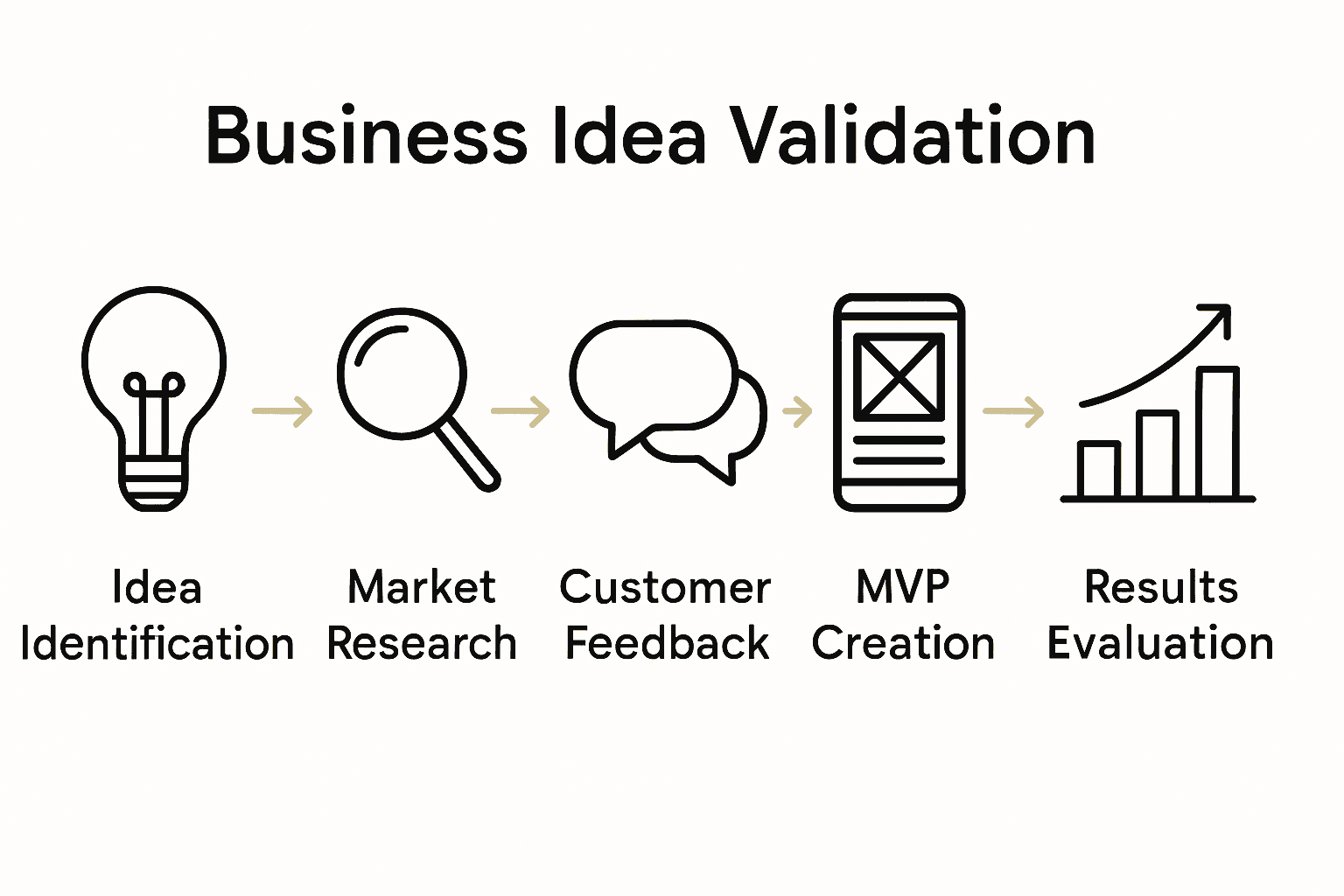
- Step 1: Identify And Clarify Your Business Idea
- Step 2: Research And Analyze Your Target Market
- Step 3: Gather Feedback From Potential Customers
- Step 4: Test Your Business Idea With A Minimum Offer
- Step 5: Evaluate Results And Refine Your Approach
Quick Summary
| Key Point | Explanation |
|---|---|
| 1. Clarify your business idea | Take personal inventory of your skills and interests to identify a unique business idea that meets market needs. |
| 2. Conduct thorough market research | Gather demographic information and analyze competitors to build a solid understanding of your target market and its demands. |
| 3. Gather and analyze customer feedback | Use surveys and interviews with potential customers to validate your business idea and tailor your offerings accordingly. |
| 4. Develop a minimum viable product | Create a basic version of your product or service to test your value proposition and gather real-world feedback for adjustments. |
| 5. Evaluate and refine your approach | Establish a framework for assessing results to ensure your business adapts based on customer insights and market trends. |
Step 1: Identify and Clarify Your Business Idea
Turning your passion into a profitable home business starts with crystallizing a solid idea that meets real market needs. According to the U.S. Small Business Administration, identifying the right startup business involves a strategic four-step process that helps entrepreneurs transform their dreams into actionable plans.
Begin by taking a comprehensive personal inventory of your skills, interests, and experiences. What unique talents do you possess that could solve problems for others? Look beyond your current job and consider hobbies, side projects, or specialized knowledge you’ve accumulated. The goal is to connect your personal strengths with genuine market demands. As the SBA recommends, list your passions and commitments first, then cross reference those with potential customer needs.
Next, conduct targeted market research to validate your concept. This means understanding who would actually pay for your product or service and what specific problems you solve for them. Use online tools, survey potential customers, and analyze competitor offerings to refine your business idea. Entrepreneurship Step by Step: Build a Business from Home provides additional guidance on transforming your initial concept into a viable business model.
Warning: Passion alone won’t guarantee success. Your business idea must solve a real problem and demonstrate clear market potential. Be prepared to pivot and adapt as you learn more about customer preferences and market dynamics.
Step 2: Research and Analyze Your Target Market
Successful businesses are built on deep understanding of their potential customers and the marketplace they aim to serve. Coursera emphasizes that comprehensive market analysis is crucial for projecting the potential success of your business before investing significant time and resources.
Start by gathering detailed demographic information about your potential customers. Who are they? What are their age ranges, income levels, geographic locations, and specific pain points? Use online research tools, social media insights, and local business directories to build a comprehensive customer profile. According to the U.S. Small Business Administration, understanding consumer behavior and economic trends will help you assess market demand and determine appropriate pricing strategies.
Dive deeper into competitive research by analyzing similar businesses in your niche. What services do they offer? What are their strengths and weaknesses? Create a comparison matrix that highlights how your business will differentiate itself. Look for gaps in the market that your unique skills and approach can fill. Tools like Google Trends, industry reports, and customer review sites can provide valuable insights into market needs and opportunities.
Warning: Market research is an ongoing process. Consumer preferences and market dynamics change rapidly, so commit to continuous learning and adaptation. What works today might need significant adjustments tomorrow.
Step 3: Gather Feedback from Potential Customers
Validating your business idea requires direct engagement with potential customers who can provide authentic insights into your proposed solution. U.S. Department of Commerce emphasizes the critical importance of primary market research that involves collecting information directly from potential buyers to precisely tailor your business offerings.
Design a strategic feedback approach that goes beyond casual conversations. Create targeted surveys or interview scripts that explore specific aspects of your business concept. OpenStax recommends selecting a representative sample of your target market to ensure statistically significant results. Leverage online platforms like Google Forms, SurveyMonkey, or social media groups to reach your potential customer base. Ask pointed questions about their current challenges, willingness to pay for solutions, and what features would make your offering compelling.
Consider multiple feedback channels to gather comprehensive insights. This might include one-on-one interviews, online surveys, focus groups, or even prototype testing with a small group of potential customers. Pay close attention not just to what people say, but how they say it.
 Look for emotional responses, hesitations, and enthusiastic reactions that can reveal deeper market needs.
Warning: Feedback is a gift, but not all feedback is equally valuable. Learn to distinguish between constructive criticism that can improve your business and noise that might distract you from your core vision. Always seek feedback from people who represent your actual target market.
Step 4: Test Your Business Idea with a Minimum Offer
Taking your business concept from theory to reality requires creating a minimum viable product that demonstrates your core value proposition. U.S. Small Business Administration recommends building a prototype that directly addresses the fundamental problem your potential customers are experiencing.
Craft a lean, focused version of your product or service that captures the essential value you plan to deliver. This minimum offer should be simple yet powerful enough to showcase your unique solution. Consider offering a basic service package, a prototype product, or a limited version of your proposed offering. Analyze how potential customers interact with this initial version through careful observation and direct feedback. The U.S. Small Business Administration suggests using market data and competitive landscape insights to refine your approach and identify potential opportunities for improvement.
Prepare to be flexible and responsive during this testing phase.
Warning: A minimum offer is not about perfection. It is about learning, adapting, and proving your core business concept can solve real customer problems. Be prepared to iterate quickly and embrace constructive feedback as your most valuable resource.
Step 5: Evaluate Results and Refine Your Approach
Successful business development requires a systematic approach to analyzing your initial market testing results. Better Business Bureau emphasizes the critical importance of evaluating industry trends, defining target customers, and analyzing competitive landscapes to refine your business strategy.
Create a comprehensive evaluation framework that goes beyond surface level observations. Develop a scoring system that captures key performance indicators such as customer acquisition cost, engagement rates, feedback quality, and potential revenue generation. American Marketing Association recommends conducting a thorough market analysis that helps identify precise opportunities for strategic improvements. Look for patterns in customer feedback, unexpected challenges, and potential pivot points that could strengthen your business model.
Be prepared to make data driven decisions that might require significant adjustments to your original concept. Successful entrepreneurs understand that initial ideas are rarely perfect and that flexibility is a key ingredient in business success. Consider creating multiple iterations of your minimum viable product based on the insights you gather, always maintaining a clear focus on solving your target customers fundamental problems.
Warning: Avoid becoming emotionally attached to your original business concept. The most successful entrepreneurs are those who can objectively assess feedback and make tough decisions about modifying or even completely reimagining their initial approach.
Turn Your Validated Business Idea into a Thriving Home Venture
Starting a home business means tackling challenges like market research, customer feedback, and testing your minimum offer. This guide highlights the struggle of turning passion into profit with real market validation and continuous adaptation. You might be feeling uncertain about how to refine your idea or where to begin building confidence in your business skills.
Prosperual understands these hurdles and supports single mothers ready to escape the 9 to 5 grind and create a sustainable income from home. With our flagship digital product, Thrive and Prosper, you gain practical strategies for developing your business, managing money, and leveraging modern tools like AI—all tailored to empower you and your family.
Discover how you can transform your validated idea into a profitable reality today. Visit Prosperual and take the next step toward financial independence. Don’t wait to build the confident, successful business you and your children deserve. Explore insights from Entrepreneurship Step by Step and start your journey now.
Frequently Asked Questions
How can I identify a viable business idea for starting at home?
To identify a viable business idea, begin by listing your skills, interests, and experiences. Then, cross-reference these with market needs to find a problem your skills can solve. Spend some time conducting online research or surveys to gauge demand.
What steps should I take to conduct market research for my home business?
Start by gathering demographic information about your potential customers, including their age, income, and specific needs. Create a profile based on this data and analyze competitors to identify gaps in the market that your business can fill.
How can I gather effective feedback from potential customers about my business idea?
Collect feedback by designing targeted surveys or conducting interviews with a representative sample of your target market. Ask specific questions about their challenges and what solutions they would find valuable, ensuring you capture both their needs and emotional responses.
What is a minimum viable product, and how do I create one for my business?
A minimum viable product (MVP) is a simplified version of your product that demonstrates its core value. Focus on developing the essential features necessary to solve a problem for your target customers, then test it to gather insights on their interactions and feedback.
How do I evaluate the results of my initial market testing?
Create a scoring system to assess key performance indicators such as customer engagement and feedback quality. Analyze patterns in the collected data to identify areas for improvement and consider making adjustments to your business concept based on these insights.
Why is it important to be flexible when testing my business idea?
Flexibility is crucial because initial ideas may not be perfect and need adjustments based on real-world feedback. Be prepared to pivot your approach based on what you learn from customer interactions to better meet their needs.