

Entrepreneurship Step by Step: Build a Business from Home
More than 15 million american adults run successful businesses from home, proving this path is more achievable than ever. The freedom and flexibility of home entrepreneurship attract people with all kinds of skills, but getting started can feel overwhelming if you do not have a clear roadmap. This guide offers practical steps to help you turn your strengths into a thriving business, from assessing your abilities through scaling your venture with confidence.
Table of Contents
- Step 1: Assess Your Strengths And Set Clear Goals
- Step 2: Research Profitable Ideas And Identify Your Niche
- Step 3: Create A Simple Business Plan And Budget
- Step 4: Leverage Online Tools And AI For Productivity
- Step 5: Launch Your Business And Test Your Offer
- Step 6: Evaluate Progress And Refine Your Approach
Quick Summary
| Key Point | Explanation |
|---|---|
| 1. Assess Your Strengths Honestly | Create an inventory of your skills and personal strengths, recognizing both your advantages and areas needing improvement. |
| 2. Validate Your Business Idea | Research potential market demand by engaging with potential customers and understanding their needs before launching. |
| 3. Develop a Simple Business Plan | Craft a clear, concise business plan that outlines your value proposition, market analysis, and financial projections. |
| 4. Leverage Online Tools for Efficiency | Identify digital tools that automate tasks and enhance productivity, focusing on those that directly meet your business needs. |
| 5. Track Performance and Adapt Strategies | Establish a system to monitor key metrics and be ready to pivot based on customer feedback and performance analysis. |
Step 1: Assess Your Strengths and Set Clear Goals
Starting a home business begins with understanding your unique capabilities and establishing strategic objectives. According to UNCTAD, reviewing your personal entrepreneurial competencies is crucial for improving business performance and setting yourself up for success.
To effectively assess your strengths, start by creating a comprehensive inventory of your skills, experiences, and natural talents. Consider areas where you excel professionally and personally. Ask yourself questions like: What tasks do I complete with ease? Where do I consistently receive positive feedback? What skills have helped me succeed in previous jobs or personal projects? Write these down in a dedicated notebook or digital document.

As recommended by the Small Business Enterprise Council, honest self assessment helps you understand what unique value you can bring to the market. This process isn’t about highlighting only your positives but also acknowledging areas where you might need improvement or additional support. Consider creating two columns: one for strengths and another for skills you want to develop.
Once you’ve mapped out your capabilities, transform these insights into specific, measurable goals. Instead of vague statements like “I want to be successful,” craft precise objectives such as “I will generate $2,000 monthly income from my digital marketing services within six months.” This approach provides clear direction and helps track your progress systematically.
Warning: Be brutally honest with yourself during this assessment. Sugarcoating your abilities or ignoring potential weaknesses will only hinder your entrepreneurial journey. The more accurately you understand your starting point, the more effectively you can chart your path forward.
Next, you’ll move into selecting a business idea that aligns perfectly with your identified strengths and goals.
Step 2: Research Profitable Ideas and Identify Your Niche
In this crucial stage, you will transform your personal strengths into a viable business concept that meets real market demands. According to the Small Business Administration, identifying the right startup idea involves a strategic four-step process that begins with understanding your unique value proposition.
Start by exploring the intersection between your passions and potential market opportunities. Traffic Salad recommends reflecting on your hobbies, professional experiences, and personal life to uncover unmet consumer needs. Make a comprehensive list of your skills, interests, and potential service areas. Then research each potential niche by asking critical questions: Are people actively seeking solutions in this space? What problems can you solve uniquely?
To validate your business idea, engage directly with potential customers. Join online communities, forums, and social media groups related to your niche. Read discussions, ask questions, and observe pain points. Look for recurring themes that suggest genuine market demand. Pay attention to the language people use when describing their challenges this will help you refine your value proposition and speak directly to your target audience.
Warning: Avoid falling in love with an idea before validating its market potential. Just because you find something interesting doesnt mean customers will pay for it. Conduct thorough research and be prepared to pivot if the market signals are not promising.
Next, youll develop a preliminary business model that transforms your niche insights into a practical action plan.
Step 3: Create a Simple Business Plan and Budget
In this critical stage, youll transform your business idea into a structured roadmap for success. According to Interes Journals, a well-defined business plan is essential for converting your entrepreneurial vision into a profitable venture that outlines your goals, strategies, and financial projections.
Begin by crafting a clear value proposition that succinctly describes the unique problem your business solves. Budgeting for Single Moms: Complete Success Guide can help you understand the financial fundamentals. Your business plan should include key sections: an executive summary, market analysis, service or product description, marketing strategy, operational details, and financial projections. Focus on creating a document thats concise yet comprehensive.
For your budget, start by categorizing potential expenses into fixed and variable costs. Fixed costs might include monthly subscriptions, equipment, or software, while variable costs could be marketing expenses, supplies, or part-time support. Track every potential expense meticulously. Create a spreadsheet with columns for projected monthly income, expected expenses, and potential profit margins. Be conservative in your estimates and build in a financial buffer for unexpected challenges.
Warning: Avoid the common mistake of creating an overly complex business plan. Your first version should be a living document that you can adjust as you learn and grow.
Next, youll explore practical strategies for funding and launching your home business with minimal initial investment.
Step 4: Leverage Online Tools and AI for Productivity
In this transformative stage, youll discover how digital technologies can supercharge your home business efficiency. According to IJIET, leveraging online tools and AI is crucial for streamlining operations, improving decision making, and fostering innovation in entrepreneurial ventures.
Start by identifying the key areas of your business that could benefit from automation and digital support. 7 Practical AI Tools for Single Moms to Boost Income offers insights into practical technological solutions. Focus on tools that help with task management, communication, financial tracking, marketing, and customer engagement. Explore AI powered platforms that can assist with content creation, social media scheduling, email marketing, and customer service chatbots. These technologies can help you work smarter not harder, freeing up precious time to focus on growing your business.
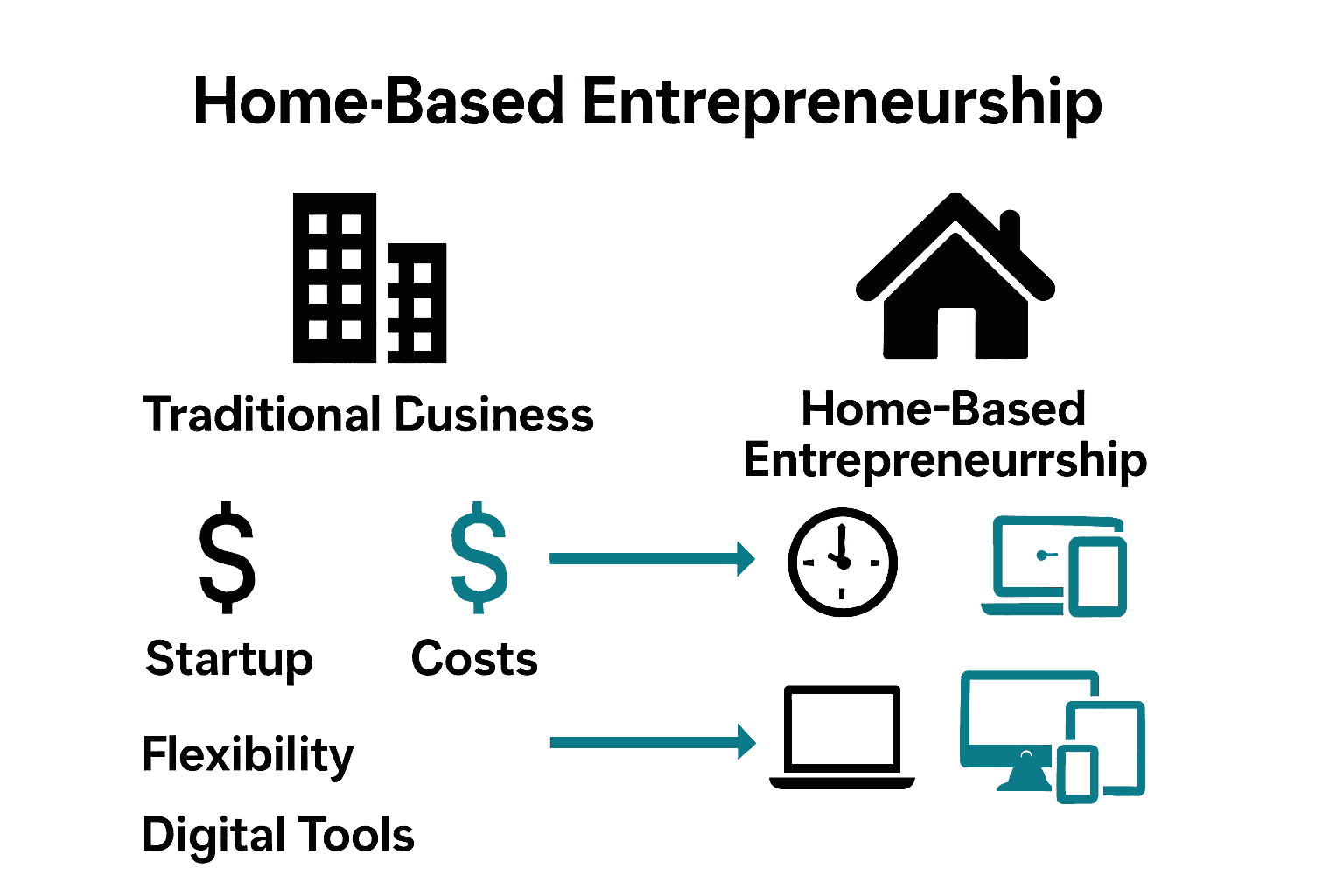
When selecting digital tools, prioritize platforms that integrate seamlessly with each other and offer user friendly interfaces. Create a technology ecosystem that supports your specific business needs. Begin with free or low cost options and scale as your business grows. Consider tools like project management platforms, cloud storage solutions, digital payment systems, and AI assisted design and writing tools that can dramatically reduce your workload.
Warning: While technology can be incredibly helpful, dont fall into the trap of tool overwhelm. Select a few key tools that genuinely solve your specific business challenges rather than collecting subscriptions that you never fully utilize.
Next, youll learn how to market your business effectively using these digital tools and platforms.
Step 5: Launch Your Business and Test Your Offer
At this crucial moment, youll transform your carefully planned business concept into a real world venture. According to the Small Business Administration, the key to success is building a prototype that solves your customers core problems and testing it directly with potential customers to validate your business idea.
Start by creating a minimum viable product (MVP) that demonstrates your core value proposition. This doesnt need to be perfect or fully polished. Your goal is to get real world feedback and understand how potential customers interact with your offering. Develop a simple version of your product or service that clearly communicates your unique solution. Then, identify a small group of potential customers who match your target market. Top Business Tools for Single Moms can help you find platforms to connect with your audience and gather initial insights.
Collect feedback through multiple channels. Offer your MVP at a reduced rate or even for free in exchange for detailed customer insights. Use surveys, direct interviews, and analytics to understand how people perceive your offering. Pay attention to not just what people say, but how they interact with your product. Look for patterns in their feedback and be prepared to make quick adjustments. According to Interes Journals, successful entrepreneurs are those who can adapt rapidly based on market feedback.
Warning: Dont take initial feedback personally. Some criticism might feel harsh, but its invaluable information that can help you refine your business before making significant investments.
Next, youll learn strategies for marketing and growing your new business.
Step 6: Evaluate Progress and Refine Your Approach
In this critical stage, youll transform your initial business efforts into a sustainable and growing venture by systematically analyzing your performance. According to UNCTAD, evaluating progress is essential for entrepreneurs to understand their business trajectory and make strategic adjustments.
Establish a consistent performance tracking system that goes beyond simple financial metrics. Create a dashboard that captures key performance indicators relevant to your specific business. 7 Practical AI Tools for Single Moms to Boost Income can help you find tools to streamline this process. Measure metrics like customer acquisition cost, conversion rates, client satisfaction, repeat business percentage, and time spent on different business activities. Schedule monthly or quarterly review sessions where you critically examine these metrics and honestly assess what is working and what needs improvement.
Be prepared to pivot and adapt based on your findings. According to the Small Business Administration, gathering customer feedback and analyzing market response are crucial for long term success. Dont view changes as failures but as opportunities for growth. If certain strategies are not delivering expected results, be willing to experiment with new approaches. This might mean adjusting your pricing, refining your marketing strategy, expanding or narrowing your target market, or even slightly modifying your core offering.
Warning: Avoid analysis paralysis. While its important to track metrics, dont get so caught up in data that you stop taking action. Use insights to inform decisions, not to create endless loops of overthinking.
Next, youll learn advanced strategies for scaling and expanding your home business.
Take Control of Your Home Business Journey Today
Building a business from home can feel overwhelming when faced with questions about where to start, how to manage finances, or how to use AI tools effectively. This article highlights the challenges of assessing your strengths honestly, researching the right niche, and creating a realistic plan. If you are ready to escape the 9 to 5 grind and build a confident, sustainable income while caring for your family, you are not alone.
Prosperual understands these exact challenges and offers a practical pathway through our flagship digital product, Thrive and Prosper. This eBook is specifically crafted for ambitious single mothers who want step-by-step guidance on starting a business, mastering money management, and leveraging technology to boost productivity.
Don’t wait to turn your entrepreneurial dreams into reality. Explore how you can transform the ideas and strategies from this article into actionable steps by visiting Prosperual. Take the first step toward financial freedom and empowering your future today with expert advice designed just for you.
Frequently Asked Questions
How do I assess my strengths before starting a home business?
To assess your strengths, create a list of your skills, experiences, and natural talents. Analyze what tasks you perform easily and where you receive positive feedback. This inventory will help you identify your unique value and set a strong foundation for your business.
What steps should I take to find a profitable business idea?
To find a profitable business idea, explore the intersection of your passions and market demands. Research your areas of interest, engage with potential customers online, and look for gaps where your skills can meet needs. Validate your ideas to ensure customers are interested in what you have to offer.
How can I create a simple business plan for my home business?
Begin by defining your value proposition and detailing how your business will operate. Outline key sections like market analysis, financial projections, and marketing strategies. Keep the plan concise and treat it as a living document that you can update as you learn more about your market.
What online tools can enhance my productivity in a home business?
Identify key areas in your home business where automation can help, like task management and customer engagement. Choose user-friendly tools that integrate well and start with free or low-cost options. This will help you work more efficiently and save time in growing your business.
How do I test my business offer before fully launching?
Create a minimum viable product (MVP) that showcases your main offering and gather feedback from early users. Offer it at a reduced price or even for free in exchange for their insights. Use this feedback to refine your product and make necessary adjustments before the full launch.
What metrics should I track to evaluate my business progress?
Track key performance indicators such as customer acquisition cost, conversion rates, and client satisfaction. Create a dashboard for these metrics and review it monthly or quarterly. This consistent evaluation will help you make informed adjustments and improve your business strategy.
Recommended
- Why Start an Online Business: The Essential Guide – Prosperual
- What Is Entrepreneurship for Women? Complete Guide – Prosperual
- 7 Smart Business Ideas for 2025 to Empower Single Moms – Prosperual
- 7 Types of Remote Businesses for Single Moms to Start Today – Prosperual
- Building a Strong Online Presence: A Step-by-Step Guide for Small Businesses - Digital Marketing Agency - Market Link Solutions